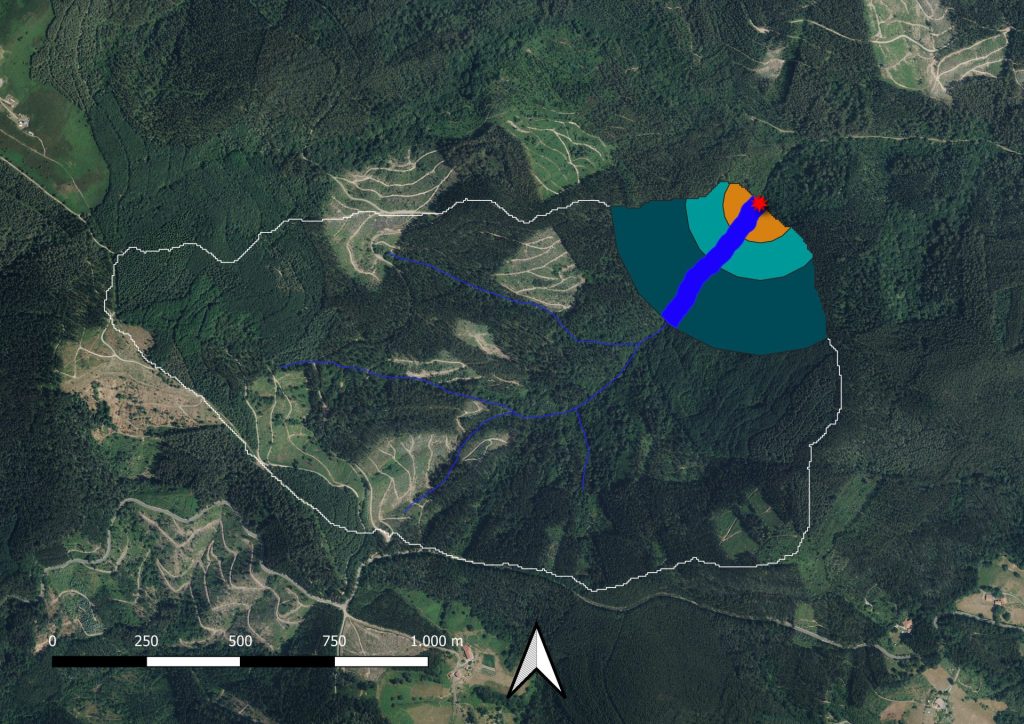
LIFE URBASO proposes four protection zones to ensure the quantity and quality of raw water from water abstraction points intended for human consumption. The names and definitions of the protection zones are as follows:
- Riparian forest: A 25-meter buffer on both sides of the river channel (blue in the image below).
- Special protection zone: Extends within a 100-meter radius upstream of the water abstraction point (orange in the image below).
- Intermediate protection zone: Extends 100 meters upstream from the special protection zone (turquoise in the image below).
- Distant protection zone: Extends 200 meters upstream from the intermediate protection zone (dark green in the image below).
The protection zones proposed by LIFE URBASO have been established in two catchments: one in the Karrakola catchment, within MUP46 in Bakio, and the other in the Mape catchment, within MUP65 in Sukarrieta. Both municipalities have signed a 15-year agreement to transfer the management of these forests to NEIKER.
he proposed management objective for the areas defined as Riparian Forest and Special Protection Zone is the CONSERVATION, as the priority ecosystem service to be preserved is drinking water production.
Transformation carried out in the Riparian Forest zone: In both catchments, regardless of their original forest cover, the river buffer has been converted into the priority habitat of community interest, known as alluvial forests of Alnus glutinosa and Fraxinus excelsior (91E0), to regulate fluvial hydromorphology and water temperature. To achieve this transformation, the girdling technique has been applied to trees with a diameter greater than 20 cm. Girdling involves the complete removal of a strip of bark (including the outer protective tissues, phloem, and cambium) around the entire circumference of a tree trunk or branch. This disrupts all phloem transport pathways, preventing the tree from conducting water and nutrients, which eventually leads to the death of the affected parts. If the tree is unable to resprout below the girdle, it will die. This technique enhances structural diversity and promotes tree-related microhabitat diversity.
Smaller trees (diameter < 20 cm) have been felled, cut into logs, and left on the ground to increase deadwood, a key element for biodiversity and climate resilience. Finally, enrichment plantings have been carried out with native riparian forest species.
Transformation in special protection zones: The same techniques used in the riparian forest areas have been applied here. However, since the target forest type in this zone is an oak forest, the species planted for restoration have been Tilia platyphillos (15%), Prunus avium (10%), Quercus robur (25%), Sorbus torminalis (10%), Sorbus aucuparia (15%), Populus tremula (10%) and Betula pubescens (15%).
LIFE URBASO will conduct a cost analysis of these transformations by the end of the project.
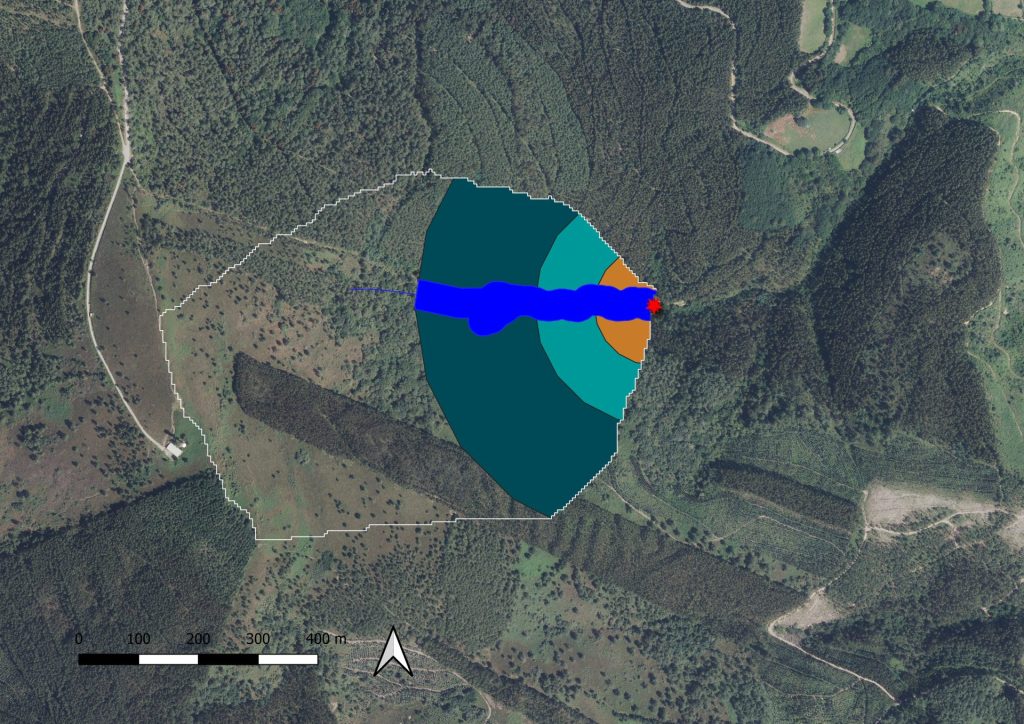
The image above shows the Mape basin with its protection zones and below, the Karrakola basin. The red star indicates the location of the water abstraction point for human consumption.