

LIFE URBASO proposes four protection zones to ensure the quantity and quality of raw water from water abstraction points intended for human consumption. The names and definitions of the protection zones are as follows:
- Riparian forest: A 25-meter buffer on both sides of the river channel (blue in the image below).
- Special protection zone: Extends within a 100-meter radius upstream of the water abstraction point (orange in the image below).
- Intermediate protection zone: Extends 100 meters upstream from the special protection zone (turquoise in the image below).
- Distant protection zone: Extends 200 meters upstream from the intermediate protection zone (dark green in the image below).
The protection zones proposed by LIFE URBASO have been established in two catchments: one in the Karrakola catchment, within MUP46 in Bakio, and the other in the Mape catchment, within MUP65 in Sukarrieta. Both municipalities have signed a 15-year agreement to transfer the management of these forests to NEIKER.
The proposed management objective for the areas defined as Medium Protection Zones and Distant Protection Zones is multifunctional forest management, with a focus on close-to-nature forestry. The primary ecosystem service in these areas is potable water production, while also allowing for the production of high-quality timber (More information on close-to-nature forestry can be found in Action B1.2).
In the Atlantic area of the Basque Country, including the Mape and Karrakola catchments, regular forestry is the predominant practice. In this management approach, all trees are of the same age and species. As a result, they reach the felling cycle at the same time and are harvested through clear-cutting, which removes all trees at once, leaving the soil exposed. In contrast, close to nature forestry maintains continuous forest cover, playing a crucial role in soil protection (more information in Action B1.2) (see image below).
Two different methods have been tested in the LIFE URBASO ctachments to transition from a regular forest model to an irregular one: direct transformation and underplanting.
Direct Transformation: When a forest stand is approaching maturity, final harvesting, or specific management needs arise, the transformation process should be applied to the tree population that will form the next generation. In this case, the trees are clear-cut and then reforested. This transformation method was applied in the Karrakola catchment, converting the original eucalyptus plantation into an irregular forest model. The final harvesting was carried out using chainsaw felling and horse logging to minimize soil impact. The effect of forestry operations on the soil was assessed using the LURSOIL protocol for monitoring forest soil disturbances. The reforestation process was conducted using native species.
LIFE URBASO has supported the creation of a new horse-logging forestry company called ArdaGaia. ArdaGaia is a company based in Oñati, founded by three partners who completed their first professional project in the Karrakola catchment under the guidance of LIFE URBASO.
Underplanting: This is another transformation model toward irregular forestry. The first step is to adjust light conditions, which requires measuring the basal area of the plot and adapting it to the light needs of the planted species through thinning (selective tree removal).
Once the light conditions are optimized, tree seedlings are planted beneath the existing canopy to promote natural regeneration and improve forest structure. This method aims to gradually shift the species composition toward a more ecologically appropriate mix, while benefiting from the shelter provided by the existing trees. This transformation model was implemented in the Mape catchment, in a 35-year-old Quercus rubra plantation, where Quercus robur has been introduced. The reforestation was carried out by planting groups of 9 and 13 Quercus robur and Betula pubescens, arranged in a diamond pattern. Each seedling was planted one meter apart, mimicking the natural regeneration pattern observed in oak forests. Additionally, B. pubescens was planted at the corners of the diamond as a nurse tree to support oak growth.
LIFE URBASO will conduct a cost analysis of these transformations by the end of the project.
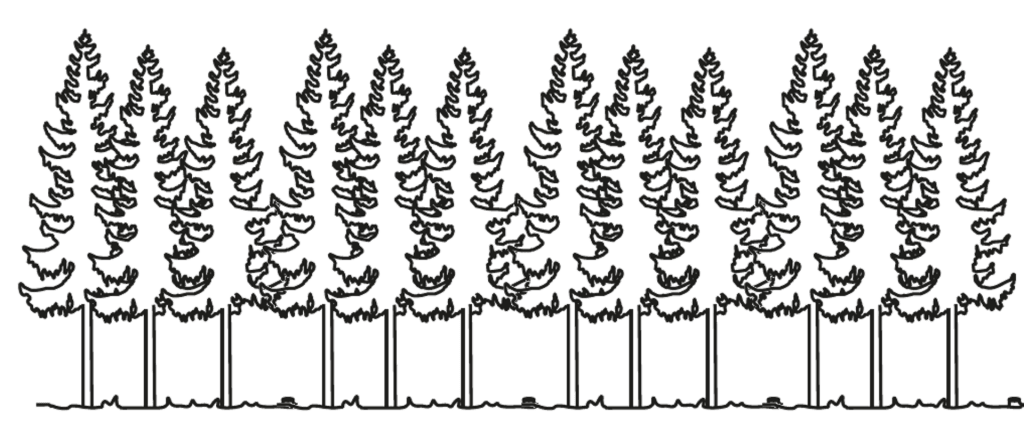
Above, you can see an example of regular forestry, and below, an example of irregular forestry or forestry close to nature. Source: PROSILVA Forestal. Measures and recommendations for carrying out forestry close to nature that maintains permanent cover (Action B1.2).
